Two documents decide what a fries line costs after it is running, and neither is the quotation: the parts list and the warranty clause. Both arrive as a short paragraph at the end of the offer, and both get skipped.
What follows is not a set of answers, but the questions worth sending back while the offer is open — and what a usable answer looks like.
1. Ask for two documents, not one paragraph
Buyers fold the two topics together because they arrive together. They protect against different things: the parts list answers what happens when a component fails and production stops, the warranty answers what happens when it fails because it was made wrong. A project can hold a wide warranty and still lose three weeks because a part that wears by design was never on the packing list. Ask for both by name, and ask who owns each on the supplier's side.
2. Ask for the list in three labelled groups
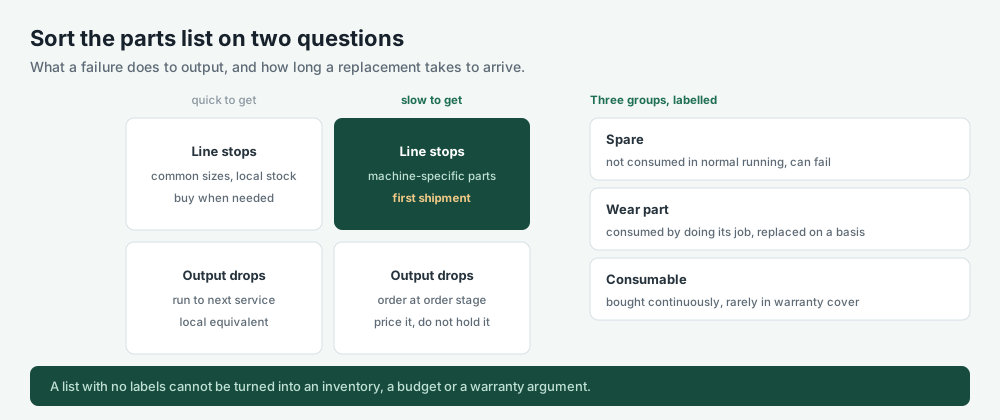
A line reading "spare parts: one lot" is not a document you can use. Ask for items grouped as spares, wear parts and consumables. The label carries three consequences at once: who pays, whether cover applies, and how the replacement moment is decided. Mixed into one number, all three become unreadable.
3. Six fields that make the list buyable from
A list of part names is a description. One you can act on answers six things per line, and the revision field is the one most often missing.
- Part number carrying the drawing revision, so it matches the machine as built.
- Quantity per machine, so a replacement quantity is calculated rather than guessed.
- Group label: spare, wear or consumable.
- Replacement basis: what tells you the part is due.
- Machine-specific or standard size, so local sourcing can be judged.
- Price basis and who arranges freight, so a replacement is not a surprise invoice.
4. For wear parts, ask what the interval is based on
"Replace every six months" describes a calendar, not a machine. One shift on soft potatoes and three shifts on cold stored material are different amounts of work on the same cutting edge.
Three bases are used: running hours for parts in continuous contact, throughput for parts acting on the product, and visible condition for parts that fail visibly before they fail functionally. Condition-based items are the ones worth asking about, because they can be changed during a planned stop. Ask what the inspection criterion is, who inspects and how often — a part replaced only after it breaks is unplanned downtime with a part number.
Tell your own team one more thing: wear is not a defect, so the warranty is no substitute for a replacement plan.
5. Ask which parts belong in the first container
The question is not which parts to buy. It is which cannot wait for a second shipment, and the answer comes from sorting twice: what happens if this fails, and how long a replacement takes to reach you.
In a potato line that corner fills with a small, predictable set: the cutting set behind the french fries cutter, a second mesh belt for the continuous belt fryer if the weave is machine-specific, sealing parts matched to your pack format, and any control module the line cannot start without. The fully automatic fries and chips configuration shows how many interfaces a full route has before you count parts.
Ask for a first-year set quoted as its own line. It puts a number on the risk without deciding anything.
6. Four questions the warranty clause has to answer
Two clauses cannot be compared unless both answer the same four questions. These are the questions, not the answers.
How long, and counted how
A duration needs a start event and a unit: months from a defined event, or running hours, or both with whichever comes first.
Which components, including bought-in ones
"The equipment" is not a scope. Ask which assemblies are covered, whether drives, instruments and control hardware are covered by the line supplier or their own maker, and whether a replacement inherits the rest of the period.
What is excluded, as a named list
This is where cover actually lives: wear parts, consumables, damage from abnormal operation or utilities outside the agreed specification, unauthorised modification, in some contracts freight and labour. Each exclusion is defensible; the problem is discovering it after a failure.
What proves a claim
Photographs of the part in place, the operating record around the failure, the part identification, the running history — so record-keeping starts on day one.
7. The start date matters more than the duration
Three start events appear in real contracts and each protects a different party. Shipment date is easy to verify but runs while the goods are at sea, so on a slow route much of the period passes before the crates are opened. Arrival at destination is better, but still starts before the line has run.
Commissioning or handover is fairest from the buyer's side, and depends on a dated record signed by both sides — the milestone the pre-arrival planning guide puts at the end of your own track. Look for the backstop too: most contracts handle a buyer-caused delay with a rule such as handover or a set date after arrival, whichever comes first. That turns your late site works into a real cost, so read it before signature.
8. Put four documents in one handover file
All of this becomes usable at handover, and only if the version filed matches the machine as installed: the parts list at the as-built revision, the record of what was fitted at commissioning, the clause as signed with the start event on the first page, and one named contact route for a claim.
The RFQ checklist covers the documents that should arrive with a quotation, the delivery terms guide settles where the price stops, and the payback check puts parts consumption and downtime in the operating cost line.
9. Frequently asked questions
Should spare parts be ordered with the machine or afterwards?
Split the list. Machine-specific parts that stop the whole line are worth having at commissioning, because a later order meets freight and clearance again. Standard parts, and parts whose failure only slows output, can wait for a local purchase.
Who pays for a replacement under warranty?
Clauses usually separate the part from the freight and the labour, and suppliers carry different portions. Ask for the three to be stated separately instead of summarised as covered or not covered.
Can local parts be used without affecting cover?
That depends on what the clause says about non-original components and modification. Ask which assemblies the rule applies to and write the answer down.