Almost every enquiry about a french fries line contains the same question: how long will it take to pay back? It is the right question to ask, and the one question a machine supplier cannot answer for you. The answer is assembled from numbers that sit on your side of the table: what your market pays for the finished product, what you can buy potatoes for, how many hours the factory will really run, and what your own costs already are.
Written for the buyer, not the engineer, this page helps you judge whether an investment case is credible before you commit budget, and separates what a supplier can confirm from what only you can supply.
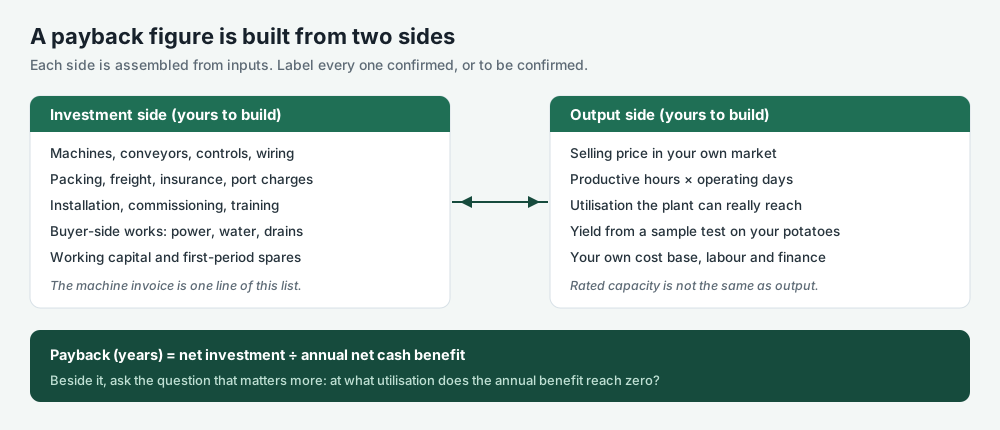
1. Split the case into two halves
Machine scope written stage by stage, connected load, the utilities the line expects and the conditions under which any performance figure holds: that is the technical half. Selling price, raw potato cost, working hours, yield, labour and finance are the other half — none of them machine properties, which is why the party selling the machines cannot quote them.
When a supplier does offer a payback figure it is usually borrowed rather than invented: it describes another plant, on another potato price and another shift pattern.
2. Five numbers that have to be yours
Before comparing two offers, each should exist on your own paper with a source.
| Number | Your source | What guessing it breaks |
|---|---|---|
| Selling price of the finished product | Your market, contracts or distributor terms | The whole revenue side scales with it |
| Raw potato cost across a full year | Purchase records, not the harvest low point | The largest recurring cost, and a seasonal one |
| Working hours and realistic utilisation | Your own shift plan and demand forecast | How thinly the fixed costs are spread |
| Yield from raw intake to finished pack | A sample test on your own potatoes | Kilos sold per kilo bought |
| Cost of finance over the period it runs | Your own bank terms | A fixed payment every period, running or not |
Two are habitually borrowed from the wrong place. Raw material cost: the harvest price and the price eight months later are different numbers. Yield: a property of your variety, solids and peel losses, not something that transfers between projects.
3. What belongs inside the investment figure
Machines are one line, not the whole list
A usable figure contains the machines with a written boundary, the conveyors, controls and wiring that join them, packing, freight and insurance, installation and commissioning, the works you carry out before start-up, first-period spares, and a contingency if the building is unsurveyed.
The two omissions that flatter every model
Working capital and buyer-side works are left out of most calculations, and both are cash. Potatoes, oil and packaging have to be bought before anything is sold; the power connection, water supply, drainage and cold-room shell normally sit outside the machine invoice. Leave them out and you have modelled the supplier's share of the project, not yours. The equipment site explains why two quotations for the same line name describe different scopes in what drives the price of a french fries line.
4. Build output from hours, never from a rating
Shift hours are not productive hours
Start-up and shutdown, cleaning between products, changeovers and planned maintenance all come out of the shift before anything is produced, and raw material availability and demand take another share. What is left is the only number that belongs in the model.
Raw intake is not finished output
Peel and sorting losses, trimming and moisture loss in frying sit between the potatoes you buy and the packs you sell, and valuing raw intake as finished product makes a weak project look viable. If you want a machine-side reference, the equipment site publishes indicative ratings per model, for example across the continuous belt fryer range; those hold for a defined product and condition, not for your cut size or frying curve.
5. Three questions to put to any payback claim
- What is inside the investment figure? Ask for the line boundary machine by machine, with works, spares, freight and working capital shown as separate lines.
- What annual output does the model assume, from how many productive hours at what utilisation? A rated capacity multiplied by calendar hours describes a plant that does not exist.
- Which assumptions are confirmed, and which are to be confirmed? Mark each line as confirmed — invoice, contract, utility bill or sample test — or not. Without those labels the model is an opinion with columns.
Then fix a convention once and keep it: before or after tax, financing inside or outside, depreciation counted or not. Changing convention mid-comparison is the usual reason two models of the same plant disagree.
6. The figure that is more useful than payback
Simple payback is a good screening tool — fast, and it exposes the two inputs that matter most — but it cannot tell you how close the project is to failing. Breakeven utilisation, the output level at which the annual net benefit is zero, turns an argument about price into a question you can answer from your own market: can this line stay above that level for a full year? Then run the model against itself, moving selling price and utilisation against the project at the same time. A project that only works in its base case has no payback period; it has a favourable spreadsheet. Once the numbers hold, the equipment site publishes automatic fries and chips line configurations to match against your output basis, and the RFQ checklist lists what to send with them.
7. Frequently asked questions
Should a supplier give me the payback period?
No. Payback depends on your selling price, raw material cost, working hours, labour and finance terms. A supplier can confirm the technical and cost basis of the line, nothing more.
What is usually missing from a payback calculation?
Working capital and the works the buyer pays for. Potato stock, oil and packaging tie up cash before the first pack is sold, and power connection, water and drainage sit outside a machine invoice.
Can I use a rated capacity as the output in my model?
No. A rated capacity is measured under defined conditions for a defined product. Annual output has to come from productive hours and a realistic utilisation factor, with yield taken from a sample test on your own potatoes.
8. Where this fits on the site
The capacity and investment guide fixes the four numbers a supplier needs before quoting; this page turns them into a test of the case. The fresh versus frozen route guide changes both sides of the model, and equipment selection covers the specification points.