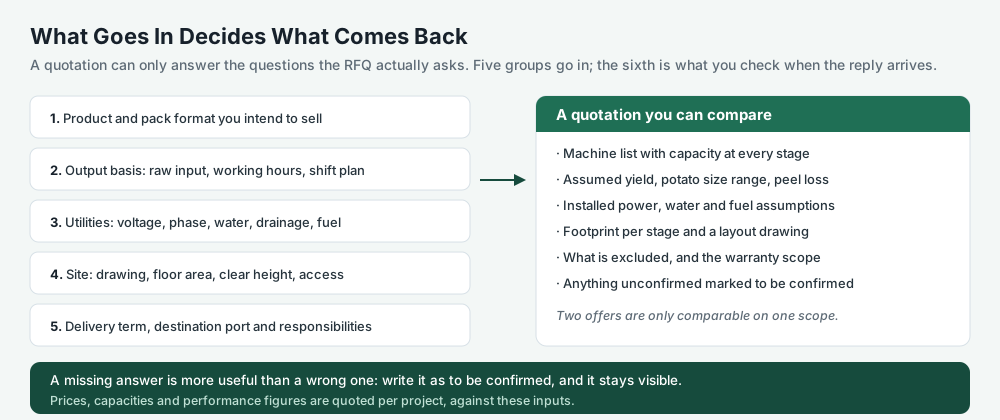
A useful supplier reply depends on the information you send. A short message that only says “send price for potato line” usually produces a rough number. A scoped RFQ lets the supplier review process route, equipment list, installed power, layout and service boundary.
1. Product and market route
| Item | What to send | Why it matters |
|---|---|---|
| Finished product | Frozen french fries, fresh fries, potato chips or mixed potato snacks. | Changes process route, cooling, freezing, seasoning and packing. |
| Product standard | Cut size, slice thickness, color, texture, oil level and packaging target. | Defines cutting, blanching, frying and inspection requirements. |
| Market channel | Food service, retail packs, distributors, restaurants or own factory use. | Helps decide packing format and automation level. |
2. Capacity and raw material
- Peak raw potato supply per day or per hour.
- Target finished product output per hour.
- Working hours per shift and shifts per day.
- Potato variety, size range, solids content if known, and storage condition.
- Expected seasonal changes in raw material supply.
3. Utility information suppliers need
Utilities decide whether a quotation is buildable. A potato line supplier cannot correctly size heating, blanching, frying, freezing or packing sections without basic site information. For frozen fries, the cold chain belongs to the line scope — the quick freezing equipment page shows the machine-level view.
| Utility item | Recommended RFQ detail | Common problem if missing |
|---|---|---|
| Electricity | Voltage, phase, frequency and available installed power. | The line may be quoted with a configuration your site cannot support. |
| Heating source | Electric, gas, diesel, steam or thermal oil preference. | Fryer cost, energy use and installation scope become unclear. |
| Water and drainage | Water source, drainage direction and wastewater limits if known. | Washing, blanching and floor layout may need later changes. |
| Cold chain | Chiller, freezer and cold room plan for frozen fries. | The supplier may quote the line without the freezing bottleneck. |
4. Layout, space and site conditions
Send the factory drawing and describe how the line has to fit inside it: floor length and width, clear height, column positions, door openings, the route raw potatoes take in and packed product takes out, and where the cold room or freezer will stand. Utilities are covered in the section above — this part is about whether the stages can be laid out in sequence with working space and future maintenance access.
5. Scope of supply
| Scope question | Confirm before quotation |
|---|---|
| Line boundary | Raw potato feeding to frying only, or through freezing and packing. |
| Packing | Local packing, supplier packing machine, weighing system or case packing. |
| Installation | Remote guidance, on-site installation, training or local contractor support. |
| Documents | Manuals, layout, packing list, commercial invoice, certificate requirements and spare parts list. |
6. Supplier reply checklist
A supplier's answer should not only contain a total price. Ask for a reply that can be compared line by line.
- Process flow and machine list, from raw potato handling to the final scope boundary.
- Key model, material, installed power and capacity basis for each main machine.
- Quoted exclusions, optional modules and items to be purchased locally.
- Suggested spare parts, wearing parts and recommended first-year stock.
- Layout drawing or at least a clear line direction with length and width requirement.
- Payment terms, production time, packing method, shipment terms and document list.
- Installation, remote guidance, training and after-sales responsibility boundary.
7. Scoping, timing and the mistakes to avoid
Not everything has to be settled before the first enquiry, and waiting for perfect information costs weeks. Split the list in two: what changes the machine selection, and what changes only the price.
- Settle before the RFQ: finished product and pack format, the output basis, peak raw material supply, voltage and available power, and where the scope boundary sits.
- Can follow with the reply: the final layout drawing, the spare parts list, the packing method, the document list and the delivery term.
One scope question is easy to forget: where the supplier's responsibility ends physically. Whether a price stops at the factory, on board at the port or at your gate changes what the project really costs, and it is covered in the guide to what a fries line price covers.
- Sending only the target finished output but not the raw potato input.
- Asking for a frozen fries line without confirming freezing and cold room scope.
- Comparing an automatic line with a semi-automatic line as if they were the same project.
- Ignoring voltage, fuel and drainage until after the machines are selected.
- Accepting a quotation with no spare parts, layout, installation boundary or acceptance basis.
Copy-ready RFQ message
Product: Frozen french fries / fresh fries / potato chips
Capacity: Raw potato input ___ kg/h; finished product output ___ kg/h
Factory: Country, voltage, available floor space, water, drainage and heating source
Scope: Washing to frying / include freezing / include packing
Support: Installation, training, spare parts and documents required
For the planning side of the same checklist, the equipment site publishes an RFQ preparation guide that reviews how to compare supplier replies line by line.
When your information is ready, send it to the main equipment supplier for a machine-by-machine review.