Two suppliers send prices for what looks like the same french fries line, and one is far lower. Sometimes the machines really do differ. More often the two numbers describe two different points on one road: one stops at the factory gate, one stops when the goods are on board at the port — and neither is the total cash the project spends before the first pack is sold.
This page covers what a delivery term puts on a supplier's side, what a landed cost figure contains, and how to bring two offers onto one basis.
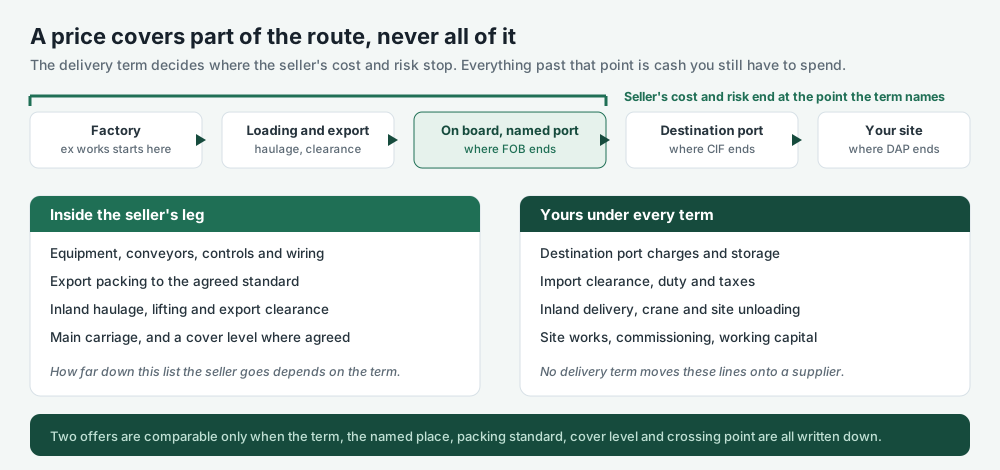
1. A delivery term divides the route, it is not a discount
A delivery term is an agreed division of tasks, costs and risks between buyer and seller, written as a short code followed by a named place.
Cost and risk travel separately, so under several common terms the seller pays the freight while the risk of loss has already passed to you — a cheaper term is not automatically a cheaper project. The named place is part of the term, not a detail. And the rules allocate delivery only: payment, ownership, warranty and liability live in the contract.
2. Five points to fix before comparing any two numbers
Five things have to be written down for each offer before any two numbers are compared: the exact delivery code, not a description such as "delivered price"; the named port or place as it should appear in the contract; the packing standard for the actual voyage length; the cover level and perils agreed; and one sentence naming the point where cost and risk become yours.
Keep scope as a separate axis: a quotation can be correctly priced on the wrong scope.
3. Where each common term stops
Most machinery contracts land on a small set of terms.
| Term | Seller's cost and risk end at | What this leaves on your side |
|---|---|---|
| EXW | The supplier's premises, not loaded | Loading, haulage, export clearance, sea leg and destination work |
| FCA / FOB | Handed to your carrier, or on board at the named port of shipment | Sea leg, insurance, destination charges, import, inland delivery |
| CFR | Freight paid to the destination port; risk passes at origin | Insurance, destination charges, import, inland delivery, voyage risk |
| CIF | As CFR, plus minimum marine cover to that port | Destination charges, import, inland delivery, any wider cover |
| DAP | The named place, import not cleared | Site unloading, import clearance, duty and taxes |
| DDP | The named place, import cleared and duty paid | Site unloading, plus what the contract excludes |
Under any term that stops at a port, that port's charges stay with the buyer, and containerised cargo changes hands at the terminal rather than on board.
4. What a machine price does not contain
Packing to the agreed standard, inland haulage, export clearance and the document set form part of a supplier's leg under most terms — written down rather than implied, because a cheap freight price can simply mean lighter crating for a long voyage.
Cash spent before the first pack is sold
Site works, installation and commissioning, first-period spares, and the cash tied up in potatoes, oil and packaging all sit outside the machine invoice and inside your budget. The equipment site shows how those blocks add up in what drives the cost of a french fries line.
5. The destination end is where budgets move
Most of the money that surprises a buyer is spent after the vessel berths, and it goes to whoever holds the goods at that moment.
- Free time, then demurrage or detention. Containers are released against a free period for collection and return; after that, charges accrue daily against whoever holds them.
- Port storage and terminal charges. If the import entry is not ready when the cargo lands, the boxes wait and storage starts.
- Unloading oversized pieces. A continuous belt fryer or a freezing tunnel does not come off a trailer on manpower, so the site crane has to exist before the delivery date.
- Cover narrower than assumed. A minimum cover written into a term is not a wider all-risk policy.
- Duty and classification. Duty follows how the goods are classified in your country — a question for your own customs broker.
6. Bringing two offers onto one basis
Three offers on three terms are not three prices for one thing; they are one price for three different things.
- One column per offer, one row per cost block. A blank row is an open question for that supplier, not a saving.
- Convert in one direction. Either bring every offer back to the factory using your own freight and insurance estimates, or forward to a delivered price using the supplier's stated figures.
- Read the packing standard and the cover level, not only their cost, and ask who pays if clearance runs long while your site team waits.
Two questions settle most of it: which part of the route does this price cover, and on the same term and scope, what would this price be?
7. What to send so a delivered price can be quoted
Freight cannot be estimated against an unnamed destination, or duty without knowing who clears the goods.
- The delivery term you intend to contract on, and whether it is flexible on your side
- The named destination port or inland place, written as it should appear in the contract
- Whether you have a forwarder and a broker, and who will act as importer of record
- Site address, road access, lifting equipment available, the largest piece the route accepts, your arrival window and the cover level you require
The technical half of the same enquiry belongs in the RFQ checklist, and the configurations it is matched against sit on the equipment site, for example in the automatic french fries and potato chips line.
8. Frequently asked questions
Is FOB or CIF better when buying a fries line?
Neither is better on its own. FOB leaves the sea leg, the insurance and the destination work with you, suiting a buyer who already has a forwarder and a broker. CIF leaves the sea leg and a minimum cover with the seller.
Does a CIF price include everything up to my factory?
No. The seller pays the main carriage and a minimum cover to the named destination port, and risk passes when the goods are on board at origin. Port charges, import clearance, duty and the inland movement normally stay with you.
Who pays import duty on potato processing equipment?
It depends on the term and the importing country: under FOB, CFR and CIF the buyer clears the goods and pays the duty assessed there.