A french fries production line is a sequence of washing, peeling, cutting, blanching, drying, frying (or not, for chilled products), chilling or freezing, and packing. The machines are straightforward; what makes projects succeed or fail is how the stages are matched to each other and to the raw material.
This guide walks the line stage by stage, then explains the two process routes — chilled (fresh) fries and frozen fries — because that choice drives everything downstream.
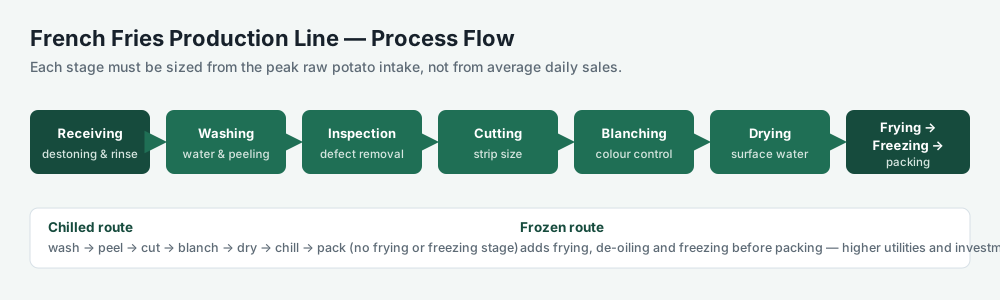
1. The stage sequence
| Stage | What happens | What to confirm with a supplier |
|---|---|---|
| Receiving & destoning | Potatoes are unloaded, destoned and rinsed of field soil | Soil load of your crop, hopper size, water consumption |
| Washing & peeling | Abrasive or steam peeling removes the skin after washing | Peel loss rate, potato size range, water recycling |
| Inspecting & trimming | Workers or optical sorters remove defects | Defect rate of your supply, staffing per shift |
| Cutting | Hydraulic or mechanical cutters produce strips of set cross-section | Cut size range (6–9 mm is common), strip straightness, knife condition |
| Blanching | Hot water or steam reduces surface sugars and enzymes for even colour | Temperature and time per potato variety, double-blanch option |
| Drying | Air knives or a dewatering step remove surface water before frying or freezing | Residual moisture, blower power, product handling |
| Frying (frozen route) | Partial or full frying sets texture and colour | Fryer type and oil management, heating source |
| Chilling / freezing | Chilled route: quick chill. Frozen route: freezing to storage temperature | Freezing method, residence time, cold store interface |
| Packing | Weighing and bagging, often in modified atmosphere for chilled fries | Pack sizes, bag material, packing at correct temperature |
2. Chilled route or frozen route
This is the first decision of the whole project, and it is a market decision, not a machine decision.
- Chilled (fresh) fries serve restaurants and QSR supply chains with short shelf life. The line needs washing, cutting, blanching or anti-browning treatment, drying and packing under good hygiene — no fryer, no freezer. Investment is lower and the chain to the customer must be fast and cold.
- Frozen fries serve retail and food-service distributors with months of shelf life. The line adds frying and freezing, and the investment and utility load rise sharply. Most export-oriented plants choose this route.
Some plants build the front of the line (washing to drying) and defer the frying-freezing block to a second phase. That works only if the building, power supply and layout were planned for the full route from day one — extending later is far more expensive than reserving space early.
3. Cut sizes and product formats
"French fries" is not one product. Food-service buyers order by cross-section and length: thin shoestring cuts around 6–7 mm, standard cuts near 9 mm, and thick steak-style cuts above 13 mm, each with minimum length grades. The cutter must hold the target size through the whole peak day, because strip uniformity drives frying uniformity and pack appearance.
- Straight cut dominates volume; the cutter and its knife condition are the quality bottleneck
- Crinkle and specialty cuts need additional cutter heads and slower speeds — price them as separate products, not variants
- Length grading after cutting separates short pieces for alternative channels; plan the space and conveyor for it
Confirm the cut size tolerance with a sample test on your own potatoes before the cutter is specified — the same machine behaves differently on different varieties.
4. Where capacity is really decided
Buyers usually compare fryer or freezer ratings, but the true bottleneck is most often upstream: peeling and inspection are labour-heavy, and cutting output must match the fryer's rhythm. Size every stage from the peak day of raw potato supply — not from the average — and give inspection enough staffing to keep the cutters fed.
Yield is the second hidden number. Peel loss, trim loss and cutting losses together decide how many tonnes of raw potatoes are needed for one tonne of finished fries. Ask any supplier to state assumed yields, then verify them with a test run on your own potatoes. A difference of a few percentage points in yield changes the required washing and cutting capacity more than most machine upgrades do.
5. Utility planning
Frying and freezing are the power-intensive stages; washing and peeling are water-intensive. Confirm installed electrical load, voltage and phase standard, water supply and drainage, and the fuel choice for frying before the machine list is finalised. A quotation that ignores utilities is not comparable with one that states them. For the wider picture — compressors, cooling water, machine-room ventilation — see the dedicated capacity and utilities material linked below.
6. What a supplier should include in a fries line quotation
- A stage-by-stage machine list, with the capacity of every stage written beside it
- The assumed yield, potato size range and peel loss behind the capacity figures
- Total installed power and the assumed voltage and phase standard
- A layout drawing with stage footprints, service access and door positions
- What is excluded: installation, commissioning, training, spares, cold store, civil works
7. From this guide to a real configuration
When your four base numbers are settled — peak supply, working hours, product route, pack format — the next step is a machine-level review. HENAN WEITUO maintains fully automatic fries line configurations and semi-automatic alternatives with stage-by-stage equipment lists, which are useful references for comparing what different suppliers include. For the buying-process side — quotations, inspections and shipping — see the capacity and investment guide on this site.