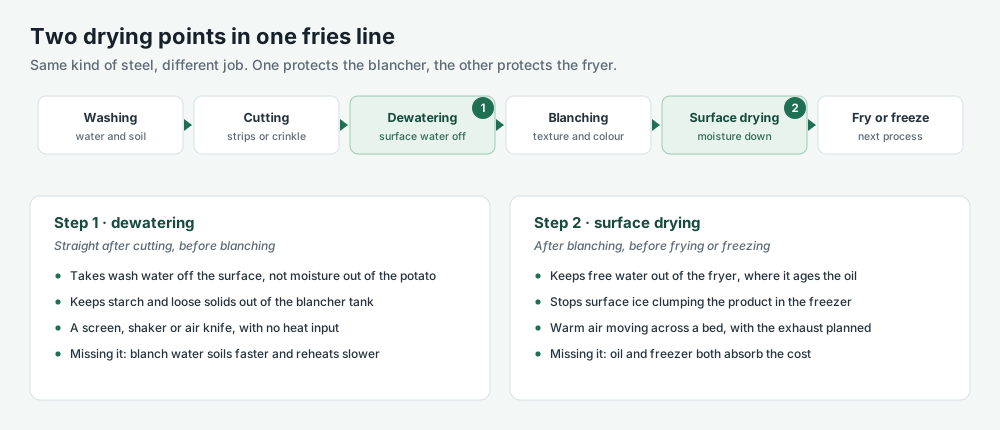
A fries line takes water off the product twice, and most buyers find out which one they bought in the first week of production. The first sits after the cutter, the second after the blancher. Both look like stainless steel, both are often quoted as one line item called the drying section, and they protect different equipment.
This page is written from the buying side: what each step is for, what to send so it can be sized, and what to check before the crates leave. The blancher between them has its own blanching process guide.
1. One word in the offer, two different machines
In conversation both are called drying. In process terms only one is. The other is dewatering: free surface water moved away mechanically, with no heat and almost no change to the potato. The difference matters, because an offer that prices one machine may answer a question you did not ask.
| Question | Step 1 — dewatering | Step 2 — surface drying |
|---|---|---|
| Where it sits | After cutting, before blanching | After blanching, before frying or freezing |
| What it protects | The blancher and its water | The fryer, the oil and the freezer |
| How it works | Screen, shaker or air knife | Blown and warmed air across a moving bed |
2. Step 1: what the cutter leaves behind
Cut strips come off the cutter wet, carrying water, starch and small fragments. Sent straight into the blancher, that load has two quiet costs: the blanch water soils faster and is changed more often, and the tank spends more of the shift recovering temperature after cold, wet product enters. Neither appears as a line item; both appear in the water and energy bill.
Ask two questions here. What removes the water — a vibrating screen, a shaker, an air knife or a combination — and where does it go? A drain that returns it to the washing stage is a small detail with a long life.
3. Step 2: what leaves the blancher
Blanched strips leave hot and wet. Surface water is free water: not bound inside the potato, and gone the moment it meets something hotter or colder. In a fryer it leaves as steam, and steam is the damage — it lifts oil off the strip, the oil works harder, and the fryer spends heat on water instead of product.
In a freezer the same water becomes surface ice, and surface ice turns a free-flowing bed into clumps that block the tunnel. That is why this step is hard to leave out on a frozen route, and why the blanching equipment and the section behind it are reviewed as one block.
Two designs appear in offers: air knives that blow surface water off, and warmed-air sections that carry it away as vapour — many lines use both, in that order. Which you need depends on the product and the room, so ask what is included, where the moist air goes, and how a multi-stage air drying section is sized for your throughput.
4. Four inputs that size both steps
Neither step can be sized from tonnes per hour alone, which is the number most buyers send first. The four inputs below let a supplier answer with a real proposal instead of a range.
- Throughput and belt width, because surface water is removed across a width, at a speed.
- Strip dimensions, since thin strips dry faster than thick ones at the same tonnage.
- Where the water comes from — spray, dip tank or blancher carryover, each leaves a different load.
- Room conditions: ambient air, exhaust capacity and where the moist air can go.
5. What a "drying section" line item has to state
Three things, at minimum: which of the two steps is quoted; what the scope includes — fans, filters, hood or duct connection, frame, control interface; and what it is promised to achieve in terms the supplier accepts being measured on. An offer with only a price has not answered.
A frozen route has more of these interfaces than buyers expect, visible in how a complete fries and chips line is assembled: each stage hands product and air to the next, and each handover is a place where a scope can end early.
6. Where these steps go wrong after handover
The air has nowhere to go
A drying section that evaporates water into an unventilated room has moved the problem. Moisture lands on cold surfaces — roof underside, machine frame — and drips back onto product. Exhaust belongs in the scope, not in a later site decision.
The bed is not maintained
Screens and belts carrying starch lose airflow, and a line accepted at one speed slowly stops drying at the same rate. Cleaning access is part of the design: if the belt cannot be reached, it will not be cleaned.
The step is bought for the wrong reason
Drying does not add capacity: the fryer, the freezer and the shift pattern set that. When buyers add drying area to chase throughput, the constraint was elsewhere and the money went where it cannot pay back. The payback check is the place to test it.
7. Agree the check before the crates ship
A drying step has no obvious output number, so acceptance gets written vaguely and settled by opinion. These three checks can be agreed in writing and made during a factory test instead of after arrival.
- No visible free water on strips leaving the step, checked by touch and by a paper or cloth test.
- No water accumulating in the receiving tank or on the fryer inlet plate during a run.
- Exhaust and duct connections identified on the drawing, with airflow direction confirmed at start-up.
8. Frequently asked questions
Can a fries line run from the blancher straight to the fryer?
It can physically run, but the water leaving with the product goes somewhere: into the fryer as free water, out as steam, taking oil quality with it. Whether that is acceptable depends on how often oil is changed and what you are frying — the step is more often missing from a budget offer than from good practice.
Is hot air always needed for drying?
No. Dewatering after cutting is mechanical — screen, shaker or air knife, no heat. After blanching most lines use blown air plus a warmed section, and how much heat depends on product, room and line speed. It should be stated in the offer, not assumed.
Does a drying step add capacity?
No. The fryer, the freezer and the shift pattern set capacity. A drying step protects oil life, freezer behaviour and batch consistency; it does not add tonnes.