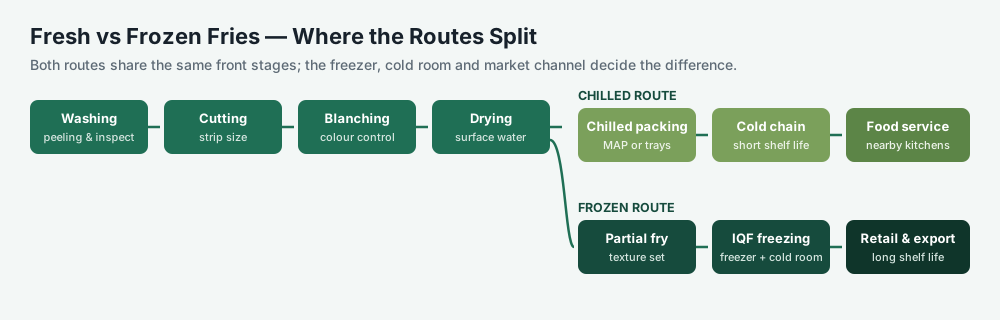
Before comparing machines or prices, every french fries project answers one question: will the product leave the factory chilled and fresh, or frozen? The two routes share washing, peeling, cutting, blanching and drying — and then split. Everything downstream differs: the fryer, the freezer, the cold room, the packing and, most importantly, the customer you can serve. Choosing the wrong route first and adjusting later is one of the most expensive corrections a potato project can make.
1. The fresh (chilled) route
Fresh fries are washed, peeled, cut, treated against browning (blanching or anti-browning dip), dried and packed under good hygiene — then delivered quickly to kitchens. There is no fryer and no freezer. The equipment list is shorter, the building needs less power and no cold storage beyond a chilled holding area, and the line is therefore the lower-investment entry into potato processing.
The trade-off is the market it can reach. Shelf life is short, distribution must be cold and fast, and the realistic customers are restaurants, QSR supply chains, canteens and local chains within a limited radius. A fresh-fries business lives or dies with the reliability of its cold chain and the density of customers nearby — the machines are rarely the bottleneck.
2. The frozen route
Frozen fries continue after drying with partial frying, cooling and IQF freezing, then frozen storage and packing. Each added stage is a real investment item: a fryer with oil management, a freezer sized to the line rhythm, a cold room, and higher installed power. The equipment selection guide lists the specification points to demand for each of these machines.
In exchange, the product gains a long shelf life and travels well. Frozen fries reach retail packs, distributors and export markets, and sales no longer depend on distance. Most buyers who plan to grow — or who already know their market includes supermarkets or neighbouring countries — end up on this route. Freezing is also what makes a fully automatic fries and chips line worth its cost, because the line can run long shifts into stock instead of into same-day delivery.
3. Side-by-side comparison
| Factor | Fresh (chilled) fries | Frozen fries |
|---|---|---|
| Stages after drying | Anti-browning treatment, chilled packing | Partial fry, cooling, IQF freezing, frozen storage |
| Key machines added | None beyond the base line | Fryer, freezer, cold room |
| Investment level | Lower — fewer heavy machines | Higher — fryer and freezer dominate |
| Shelf life | Short, days | Long, months |
| Cold chain | Chilled, fast, short radius | Frozen storage and transport, wide radius |
| Typical customers | Restaurants, QSR, canteens nearby | Retail packs, distributors, export |
| Main business risk | Cold chain reliability, customer density | Raw material cost, working capital in stock |
4. Five questions that pick your route
- Who buys the product? Kitchens nearby point to chilled; supermarkets, distributors or export point to frozen.
- How far can you deliver reliably? Honest answer within hours, not marketing hope.
- Is the power supply ready? A freezer and cold room change the utility plan — check the capacity and utility planning guide before fixing the route.
- Will you sell through seasons? Frozen stock smooths seasons; fresh product must be sold immediately.
- Do you plan to add potato chips later? Chips are fried and packed dry, so a fryer bought for the frozen route can serve both products.
5. Starting chilled, growing frozen
The two routes are not a one-time choice. A common path is to start with the chilled line — lower investment, faster to market — and design the building so the frozen stages can be added later: leave floor space after the drying stage, oversize the electrical supply and water drainage, and plan where the cold room will stand. When the frozen expansion comes, the front of the line keeps running and only the tail changes. If freezing is on your roadmap, it is worth reading the quick freezing line planning guide early, because freezer selection depends on the line capacity you size today.
Whichever route you choose, the next step is the same: fix the four numbers — product, raw material, capacity basis and utilities — and send them for review. The RFQ checklist shows exactly what a supplier needs to price either route properly.